-
TL;DR:
Line editing improves how your book reads by refining style, tone, and flow at the sentence level, while copy editing fixes errors by correcting grammar, punctuation, and consistency. Line editing comes first, then copy editing, because polishing sentences after proofreading wastes time and money. Line editing typically costs $0.04 to $0.08 per word, and copy editing runs $0.02 to $0.04 per word. Most manuscripts need both stages before publication.
More than 1,100 editors contributed pricing data to the Editorial Freelancers Association’s 2026 rate chart, representing nearly one third of its membership. Line editing vs copy editing becomes confusing when you’re looking at a real manuscript and a real budget. Line editing improves how your writing reads, while copy editing checks for correctness, clarity, and consistency.
For most finished manuscripts, line editing comes before copy editing. The right choice of book editing service can save you money because you don’t want to polish sentences you may later rewrite or remove.
You’ll see real examples, current cost ranges, a simple decision guide, publishing advice, and a practical way to decide what your manuscript needs.

-
What Is the Difference Between Line Editing and Copy Editing?
Line editing focuses on how your writing sounds and feels. Copy editing focuses on technical correctness and consistency.
A line editor asks, “Does this sentence work?” A copy editor asks, “Is this sentence right?”
That difference shapes everything: who you hire, what you pay, and when you use each service.
Factor
Line Editing
Copy Editing
Focus
Style, tone, flow, voice
Grammar, punctuation, consistency
Subjectivity
High (taste and judgment involved)
Low (rules-based)
Typical changes
Rewording, tightening, transitions
Spelling, commas, capitalization
Deliverables
Suggested edits, comments, editorial letter
Marked-up file, style sheet
When it happens
After developmental edit, before copy edit
After line edit, before proofreading
Cost range
0.04–0.08/word
0.02–0.04/word
Who needs it
Authors whose prose feels flat or clunky
Every manuscript before publication
The terms sometimes overlap in casual conversation. Some editors bundle both services. The Chicago Manual of Style, 18th Edition, treats line editing and copyediting as separate stages, with line editing best done first. When you see “copyediting vs line editing” written as one word or two, the meaning stays the same.
What Is Line Editing?
Line editing is sentence-level editing that makes your prose stronger. A line editor reads every sentence and asks whether it serves the story or argument.
This is stylistic editing. The editor cares about rhythm, clarity, and voice. They won’t restructure your chapters. They will make every paragraph pull its weight.
A line editor does these things:
- Improves writing style without erasing your voice
- Refines prose so sentences land with more impact
- Tightens sentences that ramble or repeat
- Removes wordiness and filler phrases
- Adjusts word choice and tone for your audience
- Smooths transitions between paragraphs
- Flags point-of-view shifts that confuse readers
Line-by-line editing is slow, careful work. An editor might spend an hour on 1,000 to 1,500 words. That pace explains the higher cost compared to copy editing.
You receive a manuscript with suggested edits, margin comments explaining choices, and often an editorial letter summarizing patterns. Some editors use track changes. Others send a clean version with a separate comment file.
What Is Copy Editing?
Copy editing is the rules-and-consistency pass. A copyeditor fixes grammar and punctuation, checks spelling and consistency, and makes sure your manuscript follows a style guide.
This is where correct punctuation matters most. Commas, semicolons, quotation marks, and dashes get standardized. The copyeditor ensures consistency across 300 pages: character names, place names, capitalization, numbers, and formatting.
A copyeditor will:
- Fix grammar errors and punctuation mistakes
- Correct spelling and enforce consistent spelling
- Check formatting for headings, scene breaks, and dialogue
- Flag facts that need verification (dates, titles, locations)
- Create a style sheet listing every decision made
The Chicago Manual of Style is the standard reference for most American book publishing. Academic books might use APA or MLA. Your copyeditor should know which guide fits your genre.
What a Copyeditor Will Not Do
A copyeditor won’t restructure your book. They won’t rewrite your voice. They won’t fix a weak plot or a confusing argument. Copy editing assumes the writing itself works. The job is making it clean and consistent.
Line Editor vs. Copy Editor: Skills, Mindset, and What Each Delivers
A line editor is a creative collaborator. A copy editor is a rules specialist. Both are skilled, but they bring different instincts to your manuscript.
A line editor reads like a writer. They notice when a sentence feels flat or a paragraph drags. They suggest better verbs, stronger images, and cleaner transitions. Their value comes from taste and judgment. Two line editors can look at the same sentence and offer different improvements, both valid.
A copy editor reads like a detective. They catch what others miss: a character’s eye color changing in chapter twelve, a comma splice on page eighty, a misspelled brand name. Their value comes from precision and consistency.
Many professionals offer one service more than the other. Some editors are natural line editors who also copy edit. Others specialize in copy editing and rarely touch prose style. When you hire an editor, ask which service they prefer and where their strengths lie. You’ll get better work from someone working in their zone.
The Stages of Editing a Book, in the Right Order
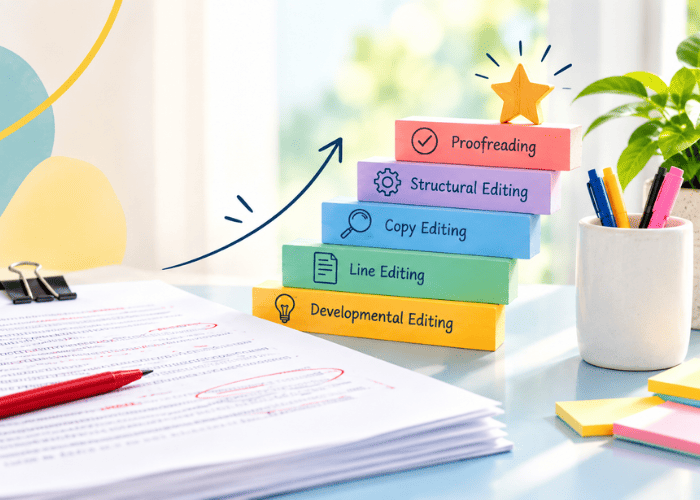
Editing stages follow a specific sequence. Doing them out of order wastes money and creates extra work. Knowing the types of book editing available, including developmental, line, copy, and proofreading, helps you recognize which stage your manuscript is ready for.
Stage
What It Fixes
When It Happens
Developmental editing (substantive editing)
Structure, plot, argument, organization
After first draft revision
Line editing
Sentence flow, style, tone, voice
After developmental changes are complete
Copy editing
Grammar, punctuation, consistency
After line edit is accepted
Proofreading
Typos, formatting errors in final files
After typesetting or formatting
Developmental editing looks at the big picture. A developmental editor might suggest cutting a chapter, adding a scene, or reorganizing your argument. This is substantive editing, and it’s the most expensive stage because it demands the most experience.
Line editing comes next. Once your structure is solid, the line editor polishes your prose. Copy editing follows. The copy editor works with clean, finished prose and applies the rules.
Proofreading is last. A proofreader checks the formatted book file for typos, missing words, and layout errors. Proofreading is not editing. Hiring a proofreader for your raw Word document wastes money.
Where Your Drafts Fit
Your first draft revision tackles big problems: plot holes, missing scenes, weak arguments. If you’re unsure how to edit a book in the right order, the stages above are the sequence professional editors follow: big-picture fixes first, then sentence-level polish, then the rules-and-consistency pass. Your second draft edit is where line editing usually happens. Your final draft edit is copy editing and proofreading. Some authors need three or four drafts before line editing makes sense.
Why Order Matters
Line editing a messy draft is expensive. The editor spends hours fixing problems a developmental edit would solve. Copy editing before line editing means the copyeditor’s careful corrections get undone when sentences change. Every stage builds on the one before it.
See the Difference: One Paragraph Through Every Stage
Original Paragraph (First Draft)
“Sarah walked into the room, and she was feeling really nervous about what she was going to say to him. The room was big, with lots of windows. She had been thinking about this moment for weeks, and now it was finally here. She took a deep breath.
After Developmental Editing
Note: The developmental editor might ask whether this scene is necessary, whether Sarah’s nervousness has been established earlier, and whether the room description matters to the story.
After Line Editing
“Sarah stepped into the room, her hands trembling. Windows lined the far wall, but she barely noticed them. Weeks of rehearsing this moment hadn’t prepared her for the tightness in her chest. She inhaled slowly.
What changed: “walked” became “stepped,” “feeling really nervous” became physical details, “thinking about this moment for weeks” became “rehearsing,” and the final sentence gained sensory weight.
After Copy Editing
“Sarah stepped into the room, her hands trembling. Windows lined the far wall, but she barely noticed them. Weeks of rehearsing this moment hadn’t prepared her for the tightness in her chest. She inhaled slowly.
What changed: Nothing visible in this example, but the copyeditor verified comma usage, confirmed consistent capitalization, and flagged “far wall” for the style sheet.
After Proofreading
The proofreader checks the typeset page. They might catch a missing period, a bad line break, or a formatting error. The words themselves don’t change.
How Much Do Line Editing and Copy Editing Cost?
Line editing typically costs $0.04 to $0.08 per word. Copy editing runs $0.02 to $0.04 per word. The Editorial Freelancers Association 2026 rate survey lists copy editing at $40 to $50 per hour and line editing at $50 to $60 per hour. Here are worked totals for three common manuscript lengths.
50,000 Words (Short Novel, Memoir, Nonfiction)
Service
Rate Range
Total Cost
Copy editing
0.02–0.04
1,000–2,000
Line editing
0.04–0.08
2,000–4,000
80,000 Words (Standard Novel, Most Nonfiction)
Service
Rate Range
Total Cost
Copy editing
0.02–0.04
1,600–3,200
Line editing
0.04–0.08
3,200–6,400
100,000 Words (Long Novel, Detailed Memoir)
Service
Rate Range
Total Cost
Copy editing
0.02–0.04
2,000–4,000
Line editing
0.04–0.08
4,000–8,000
Genre affects pricing. Fiction copy editing often runs slightly lower than nonfiction because fiction requires less fact-checking. Memoir pricing sits between fiction and nonfiction.
Editing Budget Tips
Hire line editing first if your prose needs work. You’ll get more value from a copy edit later if the sentences are already polished.
Prepare your manuscript before hiring. Run spell-check, read your work aloud, and fix obvious typos. Every hour you spend cleaning saves you money. Beta readers can catch problems before a paid editor sees them.
Consider a manuscript assessment if money is tight. An assessment gives you a roadmap, and you can revise on your own before hiring a line or copy editor.
How Long Does Each Take?
A line edit on an 80,000-word manuscript takes about two to four weeks. Copy editing runs faster because it’s more mechanical, usually taking one to three weeks. Developmental editing can take six to twelve weeks or more.
Editors book weeks or months ahead. If you need a specific turnaround, contact editors early. Rush fees apply for faster delivery.
A full editorial workup on a 130,000-word manuscript can take four to six months when done properly. That timeline includes author revisions between stages. Plan your launch date around your editing schedule, not the other way around.
Which Does Your Book Need? A Quick Decision Guide
Answer these five questions.
- Have you finished at least one full revision of your draft?
If not, you’re not ready for line or copy editing. Finish the draft, get beta reader feedback, and revise.
- Does your story or argument hold together? Are the chapters in the right order?
If not, hire a developmental editor first.
- Do your sentences feel flat, wordy, or repetitive when you read them aloud?
If yes, you need line editing.
- Are there grammar errors, inconsistent names, or punctuation problems?
If yes, you need copy editing.
- Is your manuscript clean but you want to make sure it’s ready for readers?
If yes, you need copy editing and proofreading.
You Need Line Editing If:
- Readers say your pacing drags
- Your dialogue sounds stiff
- Paragraphs feel repetitive
- You want your prose to feel more professional
You Need Copy Editing If:
- You know grammar isn’t your strength
- Character names or details change
- You’re not sure about comma rules
- You’re preparing to publish
Genre Notes
Fiction editing prioritizes line editing for voice, pacing, and dialogue. Nonfiction editing often needs developmental editing first to tighten arguments. Memoir editing combines both: line editing for emotional resonance, copy editing for factual consistency.
Indie vs Traditional Publishing: What Level of Editing Is Expected?
Indie authors pay for every editing stage before launch. Traditional publishers provide editing after acquisition, but only if your manuscript is already close to professional quality. The table shows what each path expects from you.
Editing Stage
Indie Publishing
Traditional Publishing (Before Query)
Traditional Publishing (After Deal)
Developmental editing
You hire and pay for it
You revise on your own or with beta readers
Publisher may assign an in-house developmental editor.
Line editing
You hire and pay for it
You polish prose yourself or hire an editor
Publisher provides line editing.
Copy editing
You hire and pay for it
You clean up grammar and consistency
Publisher provides copy editing
Proofreading
You hire and pay for it
Not required before querying
Publisher provides proofreading
Formatting
You handle or pay for it
Not required
Publisher handles typesetting
Cover design
You hire or design it
Not required
Publisher provides cover art
Indie authors carry the full cost and coordination of every editing stage. Traditional authors front-load the work before querying, then hand off to the publisher’s team.
Agents and acquiring editors won’t reject you for one typo. They will reject a manuscript that needs heavy line editing or developmental work. Your job is getting the manuscript to a professional level so it survives the submission process.
What to Polish Before Querying
- Clean grammar and punctuation
- Consistent formatting
- A strong hook in the first ten pages
- A complete, revised manuscript
Publishers provide copy editing and proofreading after acquisition. Some also assign a developmental editor. Everything before that point is your responsibility.
Can AI Tools Replace a Line Editor or Copy Editor?
AI tools help fix grammar errors and run basic consistency checks. They struggle with voice, judgment, and the kind of deep reading that catches an inconsistency buried on page 200 of an 80,000-word manuscript.
Grammar tools catch comma splices and misspellings. They miss a character whose personality shifts between chapters. They miss a metaphor that doesn’t land. They can’t tell you whether your narrator’s voice sounds authentic for a thirteen-year-old or a fifty-year-old detective.
A Self-Edit Workflow Before Hiring
- Run grammar software and accept the obvious fixes.
- Read your manuscript aloud. Mark sentences where you stumble.
- Search for crutch words (very, really, just, actually). Cut half of them.
- Use text-to-speech to hear rhythm problems.
- Ask beta readers to flag confusing sections.
Self-editing reduces the hours an editor needs. It doesn’t replace a human who reads 80,000 words and holds your entire story in their head.
Book Editing Services vs Individual Editors
A book editing services company assigns an editor from their staff. An individual editor works independently. Both models work. The key is matching your book with someone who understands your genre.
Manuscript editing covers line and copy editing. Comprehensive editing services bundle developmental, line, copy, and proofreading. Bundling saves coordination time but costs more upfront.
If you’re still deciding whether to handle the process yourself or hire a professional, explore our guide to choosing between professional book formatting services and DIY formatting. It can help you evaluate which approach best fits your budget, skills, and publishing goals. -
Checklist Before You Hire
- Request a sample edit of 1,000 to 1,500 words
- Get scope in writing: word count, deadline, deliverables
- Confirm the editor has genre experience
- Ask for references from two or three past clients
- Read the contract: payment terms, revision policy, cancellation
- Red flag: editor promises bestseller status or guarantees
- Red flag: no sample edit, no references, no written scope
8 Questions to Ask Any Manuscript Editor
- How many books in my genre have you edited?
- What does your sample edit include?
- Will you explain your changes or just mark them?
- What style guide do you follow?
- How do you handle disagreements about changes?
- What’s your turnaround time for my word count?
- Do you offer payment plans?
- Can I see a sample editorial letter?
What Comes After Editing?
Once editing wraps, you’re ready for book publishing support. Formatting and cover design come next. Then you need a distribution plan. Online book marketing helps readers find your book. Book advertisers can amplify your launch.
Book ghostwriting services help authors draft before editing becomes relevant. These services serve different needs at different stages.
Conclusion
Line editing and copy editing solve different problems, so choosing the right service can save you time, money, and unnecessary revisions. Line editing should usually come first when your manuscript needs stronger voice, clearer sentences, better flow, or tighter prose. Copy editing should follow when the writing is settled, and you need accurate grammar, punctuation, spelling, facts, and consistent usage.
A smart next step is to have an editor review a sample of your manuscript before you pay for a full project. Pioneer Publishing Press‘ book editing service can help you identify the level of editing your manuscript actually needs, provide clear pricing, and explain what the service includes before work begins.
Frequently Asked Questions
Which comes first, line editing or copy editing?
Line editing comes first. It fixes style and flow. Copy editing comes after, when the sentences are finalized.
Is line editing the same as copy editing?
No. Line editing improves how writing reads. Copy editing fixes grammar, punctuation, and consistency.
Is line editing more expensive than copy editing?
Yes. Line editing requires more judgment and time, so it costs more per word.
Is copy editing the same as proofreading?
No. Copy editing fixes errors in the manuscript. Proofreading checks the final formatted file.
What is the difference between line editing and developmental editing?
Developmental editing fixes big-picture issues. Line editing fixes sentence-level problems.
Is line editing the same as substantive editing?
No. Substantive editing is another term for developmental editing. It addresses structure and content.