
TL;DR
Finished writing your book? ISBN registration is one of the most important steps before publishing. An ISBN is a unique identifier that helps bookstores, libraries, distributors, and online retailers recognize and sell your book. If you’re self-publishing, buying your own ISBN gives you full ownership, greater distribution flexibility, and control over your book’s metadata. This guide explains what an ISBN is, how to register one, the differences between free and paid ISBNs, common mistakes to avoid, and best practices for publishing on platforms like Amazon KDP and IngramSpark.
You finished your manuscript, and now a different challenge starts. Many first-time authors begin searching for ISBN registration after completing their book because they suddenly realize that writing the manuscript was only one part of the journey. Many writers spend months creating a great story, although they often feel confused when technical publishing requirements start appearing.
Recent publishing data shows how competitive the market has become because self-published works with ISBNs increased by 38.7% in 2025, according to Bowker industry data reported by Publishers Weekly. More books are entering the market every year, which means visibility and proper setup matter more than ever.
That is where ISBN registration becomes important because it works as the identity of your book inside the publishing world. This guide explains what it is, why it matters, how to get it, and which mistakes can cost authors time and money later.
Many authors focus only on writing quality, while experienced publishers know that book metadata, catalog visibility, and retail systems often decide whether readers can actually find a title.
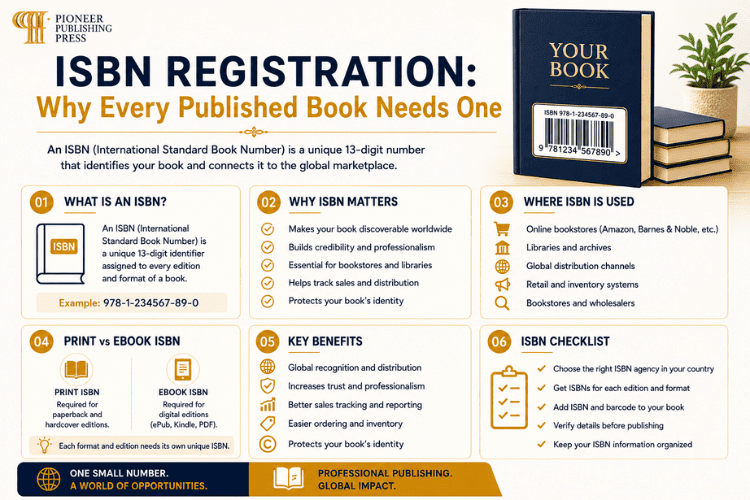
What Is an ISBN and Why Does It Matter?
An ISBN, or International Standard Book Number, is a unique 13-digit identifier assigned to a specific version of a book. People often describe ISBN registration as a fingerprint because every published format receives its own identity.
Important details include:
- Retailers use it to locate and list books accurately
- Libraries use it for cataloging and inventory systems
- Distributors use it for ordering and tracking
- Readers use it indirectly when searching online databases
Proper ISBN registration matters because your book enters a global supply chain after publication. If you are self publishing a book, major retailers usually require it for print versions.
A strong publishing foundation improves discoverability because catalog systems depend heavily on standardized book identification.
How an ISBN Works in the Publishing Ecosystem?
The publishing world runs through connected databases because retailers, wholesalers, and libraries exchange book information continuously. ISBN registration acts as the connection point that links your title information across multiple systems.
Key functions include:
- Tracks inventory movement
- Connects book metadata with retailers
- Helps libraries identify editions
- Supports ordering and sales systems
Industry organizations treat ISBN registration as a standard because books move through thousands of channels globally. When readers search for a title, publishing systems rely on those identifiers to return accurate results.
Many authors who start Kindle book publishing later expand into print because broader availability creates more opportunities. Publishing professionals often say metadata sells books quietly because readers cannot buy books they cannot find.
Free vs. Paid ISBN: Which Should You Choose?
When it comes to obtaining an ISBN, you have two primary paths: free or paid. The choice depends heavily on your goals and how you plan to publish. Free ISBNs are available from some platforms, but they come with significant limitations.
Paid ISBNs, purchased from official agencies, offer full ownership and control. You are listed as the publisher, and you can create your own imprint name. This provides professional credibility and gives you the freedom to distribute your book across any platform you choose. Here is a detailed comparison to help you decide.
|
Feature |
Free ISBN |
Paid ISBN |
|
Publisher of Record |
The platform (e.g., Amazon, IngramSpark) |
You (or your own imprint name) |
|
Distribution Flexibility |
Locked to the platform where it was issued |
Can be used on any platform worldwide. |
|
Control Over Metadata |
Very limited; often managed by the platform |
You have full control over all information |
|
Cost |
$0 |
Varies by country; $125 for a single in the US from Bowker |
|
Professional Credibility |
Displays “Independently published” |
Platform’s name Displays your own publishing imprint, offering higher prestige |
Step-by-Step Guide to ISBN Registration
Once you decide to take control and purchase your own ISBNs, the process is straightforward. The following steps will guide you through the entire registration process, from finding the right agency to assigning your ISBNs to your book.
Step 1: Find Your Country’s Official ISBN Agency
The first step is to ensure you are buying your ISBN from the correct source. You must purchase ISBNs only from the official agency designated for your country. This is crucial because buying from a third-party reseller can result in an invalid ISBN or one that lists someone else as the publisher.
Here are the official agencies for several countries:
- United States: Bowker (MyIdentifiers.com)
- United Kingdom: Nielsen UK ISBN Agency
- Australia: Thorpe-Bowker
- Canada: Library and Archives Canada (where ISBNs are provided for free)
If your country is not listed, you can check the official International ISBN Agency directory to find your local provider.
Step 2: Decide How Many ISBNs You Need
This is an important strategic decision. A common mistake new authors make is purchasing only one ISBN. The reality is that every format of your book requires its own unique identifier.
- Your paperback edition will need its own ISBN.
- A hardcover edition will require a separate one.
- You will also need an ISBN for your ebook.
- An audiobook version will need its own as well.
- A revised edition with significant new content also requires a new ISBN.
Purchasing a block of 10 is the most cost-effective option for U.S. authors. It costs $295, which averages $29.50 per ISBN, compared to $125 for a single one. If you plan to write multiple books or publish multiple formats, buying in bulk is the smarter financial choice.
Step 3: Purchase Your ISBN
After you have determined how many ISBNs you need, the purchase itself is a simple transaction. Visit your national agency’s website and create an account. This account will serve as your publisher dashboard. From there, you can select the number of ISBNs you want to buy, add them to your cart, and complete the transaction. Once purchased, these numbers are yours forever and will be available in your account to assign to your books.
Step 4: Assign Your ISBN and Register Metadata
Owning an ISBN is only half the battle. You must log in to your account and formally assign a specific ISBN to your book’s format. During this process, you will be asked to fill out the book’s metadata carefully. This includes vital details such as:
- Title and subtitle
- Author name(s)
- Publisher imprint name
- Publication date
- Book description (blurb)
- Subject categories (BISAC codes)
- Keywords
This metadata is what populates your book’s information on retailers’ websites. Accurate and complete metadata is critical for readers to find your book. The ISBN registration process is complete only when this metadata is linked to the number.
5 Common ISBN Mistakes to Avoid
Navigating the world of ISBNs can be tricky for first-time authors. Knowing the common mistakes can save you from costly and frustrating problems down the road.
Mistake 1: Buying from Non-Official Resellers
Be wary of websites offering single ISBNs for a fraction of the official price. These are frequently invalid or previously used numbers. When you buy an ISBN, the original purchaser is listed as the publisher of record, not you. This completely defeats the purpose of owning your own ISBN and can cause serious issues with distributors.
Mistake 2: Using the Same ISBN for Different Formats
This is one of the most frequent and damaging mistakes. You cannot use the same ISBN for a paperback and an ebook, or for a hardcover and an audiobook. Retailers’ systems treat each format as a separate product and require a unique identifier for each one. Using the same one will cause confusion in their inventory and order systems.
Mistake 3: Entering Incorrect Metadata
A simple typo in your book title or author name can cause significant problems. This metadata is sent to retailers and libraries worldwide. Correcting it everywhere later can be a tedious and difficult process. Always double-check and triple-check every field before you assign the ISBN and submit.
Mistake 4: Forgetting to Assign the ISBN After Purchase
Simply purchasing a block of ISBNs does not register your book. The numbers sit in your account unused until you formally assign a specific ISBN to your specific book title and format. Do not forget this critical step, as your book will not be in any database until this is done.
Mistake 5: Assuming a Free ISBN Offers the Same Flexibility as a Paid One
A free ISBN might seem like a great deal, but it locks you into a single platform. If you later decide to expand your book’s distribution, you will be unable to take that ISBN with you. You will have to purchase your own, which will mean publishing a new edition and potentially losing reviews and sales history.
Real-World Scenario: When a Free ISBN Backfires
To illustrate the risks of a free ISBN, let’s look at the real-world case of a first-time author and how a professional service can help.
Sarah Mitchell’s Story
Background: Sarah Mitchell is a first-time author who poured her heart into a historical mystery novel. Excited to get her work published, she chose the convenience of Amazon KDP and the free ISBN they offered for her paperback. For a while, her book sold well on Amazon.
The Problem: Buoyed by her initial success, Sarah dreamed of getting her book into local bookstores and libraries. She started working with IngramSpark to expand her distribution. That is when she hit a wall.
The Discovery: Sarah learned her free ISBN was locked to Amazon. Amazon was listed as the publisher of record, and IngramSpark could not accept this ISBN for distribution. She had no control over her book’s data.
The Result: To achieve her goal of widespread distribution, Sarah was forced to purchase her own ISBN and create a new edition of her book on Amazon. This new edition had a fresh product page, causing her to lose the 50+ customer reviews she had worked hard to earn and her sales ranking momentum.
Sarah reached out to Pioneer Publishing Press for assistance. The team quickly took the following steps to resolve her issues:
- Pioneer Publishing Press helped Sarah purchase a block of 10 ISBNs from the official Bowker agency.
- They assisted her in registering the correct metadata for her new edition, ensuring consistency across all platforms.
- They guided her through book publishing the new edition on both Amazon KDP and IngramSpark simultaneously, expanding her reach.
- They ensured her book was listed with her own imprint name, giving her enhanced professional credibility.
The Outcome: Within three months of these actions, Sarah saw a 40% increase in sales due to her wider availability on Amazon, IngramSpark, and local bookstores. She regained her momentum and even surpassed her previous rankings.
Sarah’s Words: She called the experience a “painful but necessary lesson” and now advises all new authors to “buy your own ISBN from day one.” This story is a powerful lesson for anyone considering a free ISBN.
ISBN and Amazon Self Publishing (KDP)
Amazon’s Kindle Direct Publishing (KDP) is a dominant force in self-publishing. It offers a free ISBN for paperback and hardcover books. Ebooks on Amazon do not require an ISBN because Amazon uses its own proprietary ASIN system instead.
When you use your own ISBN on KDP, you gain tremendous flexibility. You can publish the same book across multiple platforms like Apple Books, Kobo, and IngramSpark. However, you must ensure that the metadata you enter on KDP matches exactly what is registered with Bowker. If the information is mismatched, it can prevent publication. Additionally, the imprint name on your book’s product page will be “Independently published” if you use their free ISBN, but using your own ISBN allows you to display your own imprint name.
ISBN and IngramSpark
IngramSpark is another powerhouse in the publishing world, offering excellent distribution to bookstores and libraries. Similar to KDP, they provide a free ISBN, but they become the publisher of record. The real value is unlocked when you use your own ISBN. This provides full ownership and complete flexibility over distribution.
If you use your own ISBN on IngramSpark, it is vital that the ISBN is already registered with its metadata before you begin the publishing process. IngramSpark uses this data to connect your book to a global network of retailers and wholesalers, making it a critical step for authors who want to reach a wide audience.
ISBN for Book Distribution and Publish on Demand Services
The ISBN is the engine of book distribution. It allows retailers to track inventory, process sales, and manage returns with precision. It also makes your book discoverable in major catalogs and databases that booksellers and librarians use to find new titles. Publish on demand services like KDP and IngramSpark require ISBNs for print books. They use this number to link your book to their printing and fulfillment systems.
If you want to “go wide,” which means selling your book on multiple platforms, buying your own ISBN is not just a recommendation but a necessity. Free ISBNs are designed to lock you into a single service, limiting your long-term potential.
Conclusion
ISBN registration is more than a technical requirement because it affects discoverability, ownership, and credibility. Authors who understand ISBN registration early avoid expensive corrections later.
Whether your plan involves Amazon platforms, wider retail expansion, or future bookstore placement, your publishing setup shapes long-term opportunities. Free options may reduce costs today, although flexibility often matters more tomorrow.
Ready for the next stage of your publishing journey? Pioneer Publishing Press can simplify the process because professional support allows you to focus on writing while experienced specialists handle the publishing details.
Frequently Asked Questions
1. Do I need an ISBN for an ebook?
No, if you are selling only on Amazon, because the platform uses its own ASIN system. An ISBN becomes helpful when you want broader availability across multiple stores.
2. Can I switch from a free ISBN to my own later?
No, you cannot replace an existing ISBN with a new one. You will need to publish a new edition with a separate ISBN.
3. Where do I buy ISBNs?
Always purchase ISBNs from your country’s official ISBN agency. Buying from unofficial sellers can create ownership and metadata issues later.
4. How many ISBNs should I buy?
If you plan to publish multiple books or formats, buying a block of 10 usually provides better long-term value and flexibility.
5. Does an ISBN protect my copyright?
No, ISBN registration only identifies and tracks your book in publishing systems. Copyright protection requires a separate registration process.
6. Can two books share the same ISBN?
No, every published book format needs its own unique identifier. Duplicate use creates cataloging and retailer problems.
7. Does a workbook need an ISBN?
Yes, a workbook usually needs an ISBN if you plan to sell it through retailers, online stores, or bookstores.
8. Can I transfer ownership of an ISBN later?
Rules vary by agency and country because transfer policies are different. Check directly with your official ISBN provider.
9. Does a hardcover edition need a different ISBN?
Yes, hardcover and paperback versions count as separate products. Each format needs its own unique ISBN registration.
10. Can I use one ISBN worldwide?
Yes, ISBNs are recognized internationally because they follow global publishing standards across countries and retailers.
11. Is ISBN registration permanent?
Yes, an assigned ISBN remains attached to that specific edition permanently. It cannot be reused for another book.


Pingback: How Long Does It Take to Write a Book? Real Timelines
Pingback: How to Publish a Children's Book in 2026 (Costs & Steps)
Pingback: How to Publish a Poetry Book in 2026: Costs & Steps
Pingback: What Is Hybrid Publishing? Costs, Royalties, Rights & Benefits
Pingback: 7 Types of Book Editing Every Author Must Know (2026)