TL;DR
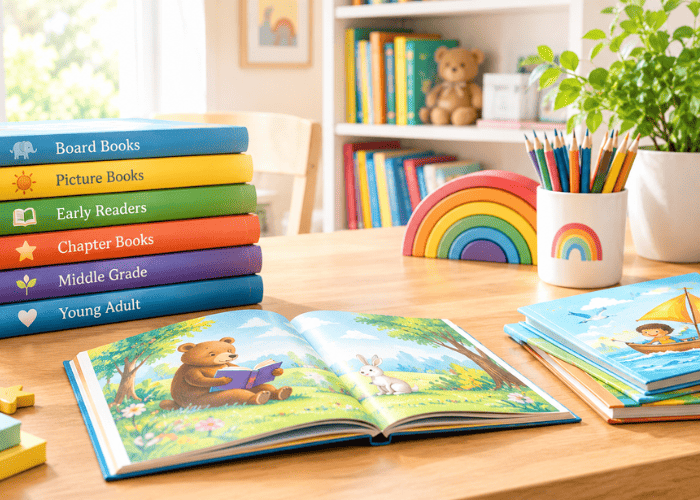
There are 12 main types of children’s books, grouped by age and format: board books, picture books, wordless picture books, concept/alphabet books, pop-up and interactive books, early readers, chapter books, middle grade, graphic novels, fairy tales/fantasy, bedtime/rhyming books, and educational/STEM books.
Reading habits change as children grow, so choosing the right book format matters. Scholastic’s Kids & Family Reading Report found that 51% of children ages 0 to 5 are read aloud to frequently at home, while only 16% of children ages 9 to 11 receive daily read-aloud time.
The children’s book market depends heavily on age categories because publishers use them to decide format, word count, reading level, and marketing strategy. Knowing these categories helps readers choose better books and helps authors create manuscripts that fit publishing expectations.
Children’s and YA book sales climbed 9.1% in April 2026 compared to the prior year, according to the Association of American Publishers. Knowing which types of children’s books fit each age is the first step to positioning your work correctly. This guide breaks down all 12 categories with real specs publishers expect, so you can write, submit, and publish with confidence.
Why Children’s Book Types & Age Categories Matter
The right book can make reading feel natural for a child. The wrong book can create frustration because the vocabulary, length, or story structure does not match their development.
Age-appropriate books for kids are not only about the number on a child’s birthday cake. Reading ability, attention span, interests, and confidence also affect what works best. Children’s book age groups help publishers, librarians, educators, and parents organize books based on expected reading skills.
A two-year-old may enjoy a short illustrated story, while a ten-year-old may prefer a longer, multi-chapter adventure. Children’s literature categories also help first-time authors understand where their manuscript belongs. An American book publisher evaluates factors such as:
- Target age range
- Story complexity
- Word count
- Illustration needs
- Reading level
- Market demand
Kids book classification gives structure to a large industry. Without categories, families and schools would find suitable books much harder.
Children’s Books by Age: Quick Comparison
|
Type |
Best age |
Word count |
Page count |
Key feature |
Example title |
|
Board books |
0 to 3 years |
0 to 300 words |
10 to 24 pages |
Durable pages and sensory learning |
Goodnight Moon |
|
Picture books |
2 to 8 years |
300 to 1,000 words |
24 to 40 pages |
Storytelling through words and art |
Where the Wild Things Are |
|
Wordless picture books |
2 to 7 years |
No written story |
24 to 40 pages |
Visual storytelling |
The Arrival |
|
Concept books |
0 to 5 years |
50 to 500 words |
12 to 32 pages |
Learning basic ideas |
Chicka Chicka Boom Boom |
|
Interactive books |
1 to 6 years |
100 to 700 words |
12 to 40 pages |
Reader participation |
Press Here |
|
Early readers |
5 to 8 years |
500 to 2,000 words |
32 to 64 pages |
Independent reading practice |
Frog and Toad Are Friends |
|
Chapter books |
6 to 9 years |
3,000 to 10,000 words |
80 to 150 pages |
Longer stories |
Ivy + Bean |
|
Middle grade books |
8 to 12 years |
20,000 to 50,000 words |
150 to 300 pages |
Complex characters and themes |
Wonder |
|
Graphic novels |
6 to 12 years |
Varies |
100+ pages |
Visual storytelling |
Dog Man |
|
Fantasy and adventure |
3 to 12 years |
Varies |
Varies |
Imagination and exploration |
Harry Potter |
|
Poetry and bedtime books |
0 to 8 years |
Short verses |
20 to 40 pages |
Rhythm and repetition |
The Very Hungry Caterpillar |
|
Educational books |
3 to 12 years |
Varies |
Varies |
Facts and skill building |
National Geographic Kids |
The 12 Types of Children’s Books
1. Board books (ages 0-3)
A board book is a sturdy book with thick cardboard pages designed for babies and toddlers who grab, chew, and throw.
Specs: 12-24 pages, under 100 words, often 6×6 inches or smaller.
Features:
- Rounded corners and non-toxic materials
- High-contrast images for developing eyes
- Simple concepts like colors, animals, or daily routines
- Touch-and-feel books and lift-the-flap books often use board book format
Examples: “Goodnight Moon” by Margaret Wise Brown (classic), “Baby University” series by Chris Ferrie (recent).
2. Picture books (ages 2-8)
A picture book tells a story through a balance of text and illustrations, where art does at least half the storytelling work.
Specs: 32 pages standard, 300-1,000 words, trim sizes around 8×10 or 10×10 inches.
Features:
- Illustration notes are usually unnecessary unless critical to the plot
- Language plays with rhythm and sound
- Themes of friendship, courage, or family
- Types of picture books range from quiet literary works to silly read-aloud favorites
Examples: “Where the Wild Things Are” by Maurice Sendak (classic), “The Day You Begin” by Jacqueline Woodson. Illustrated children’s books in this category often become classics that parents pass down for generations.
3. Wordless picture books (ages 2-7)
A wordless picture book uses only images to tell a complete story, letting children build their own narration.
Specs: 32-48 pages, zero words, any trim size.
Features:
- Builds vocabulary through description and inference
- Works across language barriers
- Encourages reluctant readers to engage without pressure
- Requires strong sequential art skills from the illustrator
Examples: “The Snowman” by Raymond Briggs (classic), “The Farmer and the Clown” by Marla Frazee (recent).
4. Concept, alphabet and counting books (ages 0-5)
A concept book teaches a specific skill or idea, such as letters, numbers, shapes, or opposites.
Specs: 24-32 pages, 100-500 words, often in board or picture book format.
Features:
- Alphabet books and counting books are the most common subtypes
- Repetition helps retention
- Interactive elements like flaps or tabs increase engagement
- Concept books for kids work best when the learning feels like play
Examples: “Chicka Chicka Boom Boom” by Bill Martin Jr. (classic), “Counting on Katherine” by Helaine Becker (recent).
5. Pop-up and interactive books (ages 1-6)
A pop-up or interactive book includes moving parts, textures, or mechanical elements that children physically manipulate.
Specs: 10-20 pages, 100-400 words, varies by complexity.
Features:
- Pop-up books require paper engineering, not just illustration
- Touch and feel books use fabric, fur, or textured inserts
- Lift-the-flap books hide surprises under paper doors
- Interactive books for kids build fine motor skills alongside reading
Examples: “The Very Hungry Caterpillar” by Eric Carle (classic), “Press Here” by Hervé Tullet (recent).
6. Early reader books (ages 5-8)
An early reader book uses controlled vocabulary and short sentences to help children transition from listening to reading alone.
Specs: 32-64 pages, 1,000-2,500 words, usually 6×9 inches.
Features:
- Sentences stay short, often under 10 words
- Pictures support comprehension but don’t carry the story
- Divided into leveled stages like “Step 1” or “Level 2”
- Best books for early readers focus on repetition and familiar situations
Examples: “Frog and Toad Are Friends” by Arnold Lobel (classic), “Elephant & Piggie” series by Mo Willems (recent).
7. Chapter books (ages 6-9)
A chapter book breaks a story into short chapters, giving young readers the satisfaction of finishing a “real” book.
Specs: 4,000-15,000 words, 64-128 pages, black-and-white illustrations throughout.
Features:
- Chapters run 2-4 pages each
- Plots stay simple with one main problem
- Characters age 6-9 so readers relate
- Series potential drives publisher interest
Examples: “Magic Tree House” series by Mary Pope Osborne (classic), “Zoey and Sassafras” series by Asia Citro (recent).
8. Middle grade books (ages 8-12)
A middle grade book tackles complex themes with characters navigating friendships, family, and identity.
Specs: 20,000-60,000 words, 150-300 pages, few or no illustrations.
Features:
- Protagonist is usually 10-12 years old
- No romance beyond crushes
- Friendships and school life drive the plot
- Can handle darker themes like loss or divorce
Examples: “Wonder” by R.J. Palacio (classic), “New Kid” by Jerry Craft (recent).
9. Graphic novels for kids (ages 6-12)
A graphic novel tells a complete story through comic panels, combining text and sequential art.
Specs: 64-200 pages, 1,000-10,000 words, full-color or black-and-white art.
Features:
- Dialogue and art share equal weight
- Appeals to reluctant readers
- Spans all genres from fantasy to memoir
- Online book publishers actively acquire graphic novels for kids
Examples: “Smile” by Raina Telgemeier (classic), “When Stars Are Scattered” by Victoria Jamieson (recent).
10. Fairy tales, fables, fantasy and adventure books (ages 3-10)
Fairy tales and fables carry cultural wisdom through magic, animals, and moral lessons.
Specs: Vary widely by format. Picture book fairy tales run 500-1,000 words. Middle-grade fantasy books for children run 30,000-60,000 words.
Features:
- Fairy tales for kids often start with “Once upon a time”
- Fables for children use animal characters to teach moral stories for children
- Fantasy books for children build entire worlds with rules and magic systems
- Adventure books for kids focus on quests and danger
- Mystery books for kids and animal books for children sit within this broader family
Examples: “The Girl Who Drank the Moon” by Kelly Barnhill (fantasy), “The Mysterious Benedict Society” by Trenton Lee Stewart (mystery).
11. Bedtime, rhyming and poetry books (ages 0-8)
A bedtime story or rhyming book uses rhythm and repetition to soothe children into sleep.
Specs: 24-32 pages, 100-800 words, often soft illustrations in muted tones.
Features:
- Bedtime stories end with closure and safety
- Rhyming books for kids must scan correctly when read aloud
- Poetry books for children vary in form from haiku to free verse
- Bedtime routines pair well with board book formats
Examples: “Guess How Much I Love You” by Sam McBratney (classic), “Goodnight, Goodnight, Construction Site” by Sherri Duskey Rinker (recent).
12. Educational, STEM, and nonfiction books (ages 3-12)
An educational children’s book teaches facts, skills, or real-world knowledge through narrative or direct instruction.
Specs: 32-64 pages, 500-5,000 words depending on age, often 8×10 inches.
Features:
- Nonfiction books for kids cover science, history, and biography books for children
- STEM books for kids make science and math engaging
- Activity books for kids include puzzles, experiments, or coloring
- Back matter like timelines, glossaries, or hands-on projects adds value
Examples: “Ada Twist, Scientist” by Andrea Beaty (STEM), “The Girl Who Thought in Pictures” by Julia Finley Mosca (biography).
Popular Children’s Book Genres
Children’s books are divided by both format and subject. A picture book can be a fantasy story, a science book, or a personal growth story. Genre describes what the story is about, while format describes how the book is presented.
1. Fairy tales for kids
Fairy tales for kids use magical elements, traditional characters, and imaginative situations. They often introduce themes such as bravery, kindness, and personal choices. Traditional fairy tales continue to influence modern children’s storytelling because they create memorable worlds with simple lessons.
2. Fantasy books for children
Fantasy books for children allow readers to explore impossible worlds filled with magic, mythical creatures, and unusual adventures. Fantasy stories can help children develop imagination because they encourage readers to think beyond everyday experiences.
3. Fables and moral stories
Children’s fables usually use animals or fictional characters to communicate a lesson. Moral stories for children help explain values through simple situations. Stories like Aesop’s Fables remain popular because children can understand the message without complicated explanations.
4. Adventure books
Adventure books for kids focus on exploration, discovery, and challenges. They often encourage curiosity because characters must solve problems and make decisions. Adventure stories come in many reading levels, from picture books to middle-grade novels.
5. Mystery books
Mystery books for kids encourage logical thinking because readers follow clues and search for answers with the characters. These stories often introduce problem-solving skills while keeping children interested through suspense.
6. Animal stories
Animal books for children connect young readers with nature and emotions. They may include realistic nonfiction information or fictional animal characters. Animal stories remain popular because children often develop strong emotional connections with animals.
Best Children’s Books by Age
The best book choice depends on a child’s age, reading confidence, interests, and attention level. Younger children usually benefit from shorter stories with strong visuals, while older children often enjoy longer plots with more complex characters.
1. Books for toddlers
Best books for toddlers feature sturdy pages, few words, and familiar routines. Look for board books with simple images and repeating phrases. “Goodnight Moon” remains the standard.
2. Books for preschoolers
The best books for preschoolers tell a complete story in under 500 words, with illustrations that invite conversation. “The Snowy Day” by Ezra Jack Keats fits perfectly.
3. Books for kindergarteners
Books for kindergarteners bridge listening and reading. Early readers with predictable text and sight words build confidence. “Elephant & Piggie” works well at this stage.
4. Books for 3-year-olds
Books for 3-year-olds should have 100-300 words, vivid illustrations, and concepts they recognize from daily life. “The Very Hungry Caterpillar” hits all three.
5. Books for 5-year-olds
Books for 5-year-olds start introducing simple plots with a beginning, middle, and end. Rhyming books for kids at this age help with phonemic awareness. “Chicka Chicka Boom Boom” teaches letters through rhythm.
Book Types vs. Book Genres: What’s The Difference?
Book types describe the format, structure, and reading experience of a children’s book, while genres describe the story’s theme, subject, and content style. A single book can belong to one format and one or more genres at the same time, such as a picture book with a fantasy theme or a middle grade mystery novel.
|
Comparison Point |
Book Types (Format) |
Book Genres (Content) |
|
Meaning |
Describes how a book is created, structured, and presented to readers |
Describes the story idea, theme, topic, or style |
|
Main purpose |
Helps define reading level, length, design, and publishing category |
Helps readers understand what kind of story or information they will find |
|
Focus |
Age group, format, word count, illustrations, and reading ability |
Themes, characters, topics, emotions, and storytelling style |
|
Common examples |
Board books, picture books, early reader books, chapter books, middle grade books, graphic novels |
Fantasy, mystery, adventure, fairy tales, animals, biography, STEM, nonfiction |
|
Age connection |
Usually connected closely with children’s book age groups and reading development |
Can appear across different age groups depending on the story complexity |
|
Illustration use |
Often determines how much artwork a book needs |
Depends on the genre and target audience |
|
Publishing decision |
Helps publishers decide manuscript length, design, and production needs |
Helps publishers position the book for marketing and readers |
|
Example 1 |
A picture book format may contain 500 words with full-page illustrations |
The same book may have a fantasy genre with magical characters |
|
Example 2 |
A chapter book format may contain several short chapters for independent readers |
The story may belong to the mystery genre because characters solve a problem |
|
Example 3 |
A nonfiction format may use facts, photographs, or diagrams |
The subject may focus on animals, science, history, or biography |
|
Why it matters for authors |
Choosing the right format helps create a manuscript that matches publisher expectations |
Choosing the right genre helps identify the target audience and market position |
For authors, understanding both systems makes manuscript positioning easier. A publisher doesn’t just look at the story idea; they also consider whether the format, target age, and genre match the current children’s publishing market.
A manuscript might be described as an “educational picture book,” a “middle grade fantasy novel,” or a “nonfiction biography for young readers.” These descriptions help publishers, booksellers, and readers quickly understand who the book is written for and where it belongs.
How to Choose the Right Type of Children’s Book to Write
Choosing the right type of children’s book to write starts with understanding your target reader. The age group, reading level, story purpose, and publishing goals will influence everything from word count and format to illustration style and submission strategy.
Many first-time authors start with a story idea without deciding who the book is actually for. A strong children’s manuscript begins with a clear reader in mind because publishers need to know exactly where a book fits in the market.
Identify your target age group.
The first step is choosing the age category for your manuscript. Each age group has different expectations for language, story length, themes, and reading ability.
|
Target Age |
Common Book Type |
Typical Purpose |
|
0 to 3 years |
Board books |
Introduce words, concepts, and early interaction |
|
2 to 8 years |
Picture books |
Build imagination, vocabulary, and emotional understanding |
|
5 to 8 years |
Early reader books |
Help children develop independent reading skills |
|
6 to 9 years |
Chapter books |
Introduce longer stories and stronger character development |
|
8 to 12 years |
Middle grade books |
Explore deeper themes, relationships, and complex plots |
An author writing for toddlers needs a different approach than someone writing for older children. A short manuscript with simple language may work well for a picture book, while a longer, character-driven story may suit middle-grade readers better.
Match your story idea with the right format.
Not every story idea fits every children’s book format. The format should support your story’s purpose, not limit it.
|
Story goal |
Suitable format |
|
Teach simple concepts or early skills |
Board books or concept books |
|
Tell an emotional story through artwork |
Picture books |
|
Help children read independently |
Early reader books |
|
Create a longer character journey |
Chapter books |
|
Explore complex themes and personal growth |
Middle grade books |
|
Use visual storytelling and dialogue |
Graphic novels |
A common publishing mistake is forcing a story into the wrong category. A detailed adventure with multiple characters may struggle as a picture book because the format has limited space for long storytelling.
Study comparable books before writing
Researching similar books helps authors understand what publishers and readers expect from a category. Comparable titles show how successful books handle structure, length, themes, and audience expectations.
Before writing your manuscript, review:
- Recently published books in the same category
- Similar age groups and reading levels
- Popular themes and storytelling styles
- Publisher preferences within the category
Comparable research does not mean copying another author’s idea. It helps you understand where your book belongs and how to position it clearly. This research also helps authors identify suitable publishing opportunities, including children’s book publishers accepting submissions that are looking for manuscripts within their preferred categories and age ranges.
Understand publisher expectations
Publishers evaluate children’s manuscripts based on more than the story concept. They also consider whether the book matches their publishing list and target readers.
Authors should research:
- Manuscript length requirements
- Illustration expectations
- Submission guidelines
- Literary agent preferences
- Publisher categories
Traditional publishers often receive many submissions, so understanding your book’s audience can strengthen your pitch.
A picture book manuscript, for example, requires different preparation than a middle grade novel. Submission materials, market positioning, and publishing approaches may all change depending on the category.
Once you understand your audience and book category, the next step is learning how to publish a children’s book and prepare your manuscript for the publishing process.
Avoid Common Mistakes When Choosing a Children’s Book Category
New authors often miss opportunities because they don’t define their book category early enough.
Avoid these mistakes:
- Writing a story without knowing the target age group
- Creating a book that tries to appeal to every child
- Ignoring current books in the same category
- Making the word count too long or too short for the format
- Choosing a category only because it appears popular
A focused manuscript gives publishers a clearer picture of the intended reader. A well-researched category choice also helps with editing, selecting the right book marketing services for authors, improving distribution opportunities, and reaching the right audience after publication.
Understanding your book category is only one part of the journey. First-time authors also need a clear roadmap from manuscript preparation to publishing decisions, which is why a guide on how to publish a book for the first time can help simplify the process.
FAQs
What are the four types of children’s books?
The four broad types are board books, picture books, chapter books, and middle grade books. These four cover the main age and reading stages from birth through age 12.
What are the different categories of children’s books?
Categories include board books, picture books, wordless picture books, concept books, interactive books, early readers, chapter books, middle grade, graphic novels, fairy tales and fantasy, bedtime and rhyming books, and educational or STEM books.
What are the main components of a children’s book?
The main components are the text, illustrations, page count, trim size, cover design, and age-appropriate vocabulary. Front matter and back matter may include a title page, dedication, glossary, or activity pages.
What are some common genres of children’s books?
Common genres include fairy tales, fantasy, fables, adventure, mystery, animal stories, realistic fiction, nonfiction, biography, and poetry. Genre describes the story content, not the reading level.
What are the different levels of children’s books?
Reading levels run from board books and picture books for ages 0-8, to early readers and chapter books for ages 5-9, to middle grade and graphic novels for ages 8-12. Each level matches a specific reading stage.
What is the most common size for children’s books?
The most common trim size for picture books is 8×10 inches or 10×10 inches. Board books usually run 6×6 inches, and chapter books typically measure 5×7.5 inches.
Turning Your Children’s Book Idea Into A Publishable Story!
Choosing the right type of children’s book helps authors create stories that connect with the right readers. Understanding age groups, formats, genres, and publishing expectations can make the writing and publishing process more focused and effective.
If you have a children’s book idea but need professional support, Pioneer Publishing Press helps authors turn concepts into polished manuscripts through expert children’s book publishing services. From writing assistance and editing to publishing guidance, our team makes the process clearer with transparent support and practical solutions at every stage of your book journey.