
TL;DR:
This guide covers how to write a book, finding and testing your book idea, choosing your genre, outlining methods for plotters and pantsers, doing research without letting it stall you, building a daily writing habit and word count goal, picking the right writing tools, and getting through a full first draft. It also covers revising and self-editing in the right order, getting feedback from beta readers, and formatting your manuscript before it goes anywhere near an agent or a publishing platform.
Writing a book feels exciting at first, while many people lose momentum once blank pages start turning into difficult decisions. New authors often struggle with choosing a topic, organizing ideas, staying consistent, and understanding what happens after the manuscript is finished. Professionals face a different challenge, as years of expertise rarely translate automatically into a structured and readable book.
A recent publishing trend shows why many people are entering the market now. Global consumer book publishing revenue remained a massive industry and exceeded $129 billion worldwide, according to market analysis from recent publishing industry reports between 2024 and 2026. Growing audiobook consumption, independent publishing growth, and creator-led book sales continue shaping the market. Writing a book has become more accessible, while competition has also become stronger.
Many first-time authors search for how to write a book for beginners because information online often feels scattered and overwhelming. Some guides explain writing but ignore publishing. Some discuss publishing while skipping the actual process of finishing a manuscript.
Pick one idea you can defend in a single sentence. Decide if you’re writing fiction or nonfiction, then check what your genre typically expects from writers. Build a simple outline before you draft, even a loose one. Write in short daily sessions instead of waiting for a free weekend. Revise in stages, big-picture changes first, line edits last. Get two or three beta readers before you touch a query letter or a KDP upload. Choose traditional, self-publishing, or hybrid publishing based on your timeline and how much control you want to keep. Publish, then treat marketing as part of the job, not an afterthought.

Understanding The Book Writing Process
Steps to writing a book fall into four stages: planning, drafting, revising, and publishing. Most first-time writers assume writing the words is the hard part. Revising and publishing usually take longer.
The Four Stages Of Writing A Book
Planning covers your idea, genre, and outline. Drafting is the messy first pass, written fast and fixed later. Revising is where a manuscript becomes a book: developmental changes first, then line-level polish. Publishing covers formatting, choosing a path to market, and getting the book in front of readers.
Each stage rewards a different mindset. Drafting rewards speed. Revising rewards patience. Mixing the two, editing while you draft, is one of the biggest reasons manuscripts stall halfway through.
Fiction Vs. Nonfiction
Fiction is built around scenes, character wants, and conflict. A novelist plans plot points and character arcs before deciding on chapter length. Nonfiction is built around an argument or a real-life story arc. A nonfiction writer plans chapters around ideas, evidence, and takeaways instead of scenes.
Memoir sits in between. It uses fiction techniques- scenes, dialogue, tension- to tell a true story. That’s why memoir writers still benefit from outlining as a novelist would.
Developing A Realistic Writing Mindset
A full-length manuscript takes most writers six months to two years, revision included. Set a real deadline, not a wish. A deadline six months out with no plan behind it won’t get you further than a deadline you actually built a schedule around.
Writing a book breaks into four stages: plan, draft, revise, publish. Fiction and nonfiction use different planning structures. A realistic timeline runs from six months to two years.
Importance Of Writing A Book In 2026
The global book market is worth well over 100 billion dollars, and it keeps growing even as reading habits shift toward audio and digital formats. Writing a book in 2026 means competing for attention across more channels than a bookstore shelf ever offered.
The State Of The Publishing Market
Print sales in the US have held roughly steady over the past two years, even as ebook and audiobook formats gain ground. Self-published titles now outnumber traditionally published ones by a wide margin, largely because platforms like Amazon KDP removed the cost and time barriers that used to keep most writers out of print.
Modern Book Discovery Channels
Ten years ago, a new author needed a bookstore deal or a strong Amazon ranking to get noticed. Readers now find books through TikTok videos, YouTube reviews, podcast interviews, and increasingly through AI search tools answering questions about what to read next. None of these channels replaced the older ones. They added more doors into the same room.
Key Changes In Publishing Since 2020
Publishing a book used to be slow and expensive by default. AI tools now handle brainstorming, first-pass editing, and research faster than ever, though readers have also gotten sharper at spotting thin, AI-written content. Quality still separates the books that sell from the ones that sit.
The book market keeps growing past 100 billion dollars globally. Discovery now happens across social video, podcasts, and AI search, not just bookstores. Reader skepticism toward thin AI content has made genuine quality a bigger advantage, not a smaller one.
Step 1: Find And Validate Your Book Idea
How to start writing a book comes down to one test: can you explain your idea in a single sentence that makes someone want to hear more? If you can’t, the idea isn’t ready yet.
Building A Strong Book Concept
Ask what your book is actually about, not the general topic, the specific angle. Ask why the story or argument matters to you personally. Ask who would pick this book off a shelf and why. If your answer to that last question is “everyone,” pick a narrower audience. Broad ideas turn into thin books.
Crafting A One-Sentence Book Premise
Write your book’s premise in a single sentence before you write anything else. A workable premise names your main character or main idea, the central problem, and the stakes. “A retired detective takes one last case to save her estranged daughter” works. “A book about detectives” doesn’t.
Validating Your Book Idea
Search your book’s likely category on Amazon and look at what’s actually selling in it. Check Google Trends for your topic or genre over the past two years. If you’re writing nonfiction, look at the questions people ask in forums and reviews of similar books. That’s what readers actually want answered.
Validating A Nonfiction Book Idea
Nonfiction succeeds when it solves a real problem for a real audience. Before drafting, check whether people are already paying for courses, coaching, or other books that solve the same problem. If nobody spends money on the problem, a book about it will struggle too.
Common Book Idea Mistakes
Writers often commit to an idea that’s really a blog post stretched too thin. Others chase a trending genre they have no real interest in, and it shows in the writing by chapter three. The safest idea is one you’d want to read yourself, in a category you already understand.
A workable premise fits in one sentence with a clear character or idea, a problem, and stakes. Check Amazon categories and Google Trends before committing months to an idea. Write toward interest you already have, not a trend you’re chasing.
Step 2: Choose Your Genre And Know Your Audience
How to write a novel starts with picking a genre, because genre sets reader expectations for pacing, length, and tone before you write a single scene.
Understanding Fiction Genres
Romance readers expect a satisfying relationship arc and, in most subgenres, a happy ending. Fantasy and science fiction readers expect a built world with consistent rules. Thriller and mystery readers expect momentum, a question that keeps them turning pages. Literary fiction readers expect voice and depth over plot speed. Young adult readers expect a protagonist close to their own age, facing problems that matter at that stage of life.
Understanding Nonfiction Categories
Memoir readers want a true story told with scene and emotional honesty, not a timeline of events. Self-help and business readers want a clear framework they can apply, not just personal reflection. Narrative nonfiction blends reporting with storytelling, built around real events told like a novel.
Choosing Comparable Titles
Comp titles, short for comparable titles, are recent, similar books you can point to as proof your book fits a market. Agents and self-publishing algorithms both lean on comps: agents to judge if your book fits their list, Amazon’s system to decide which readers to show your book to. Pick two or three comps published in the last three years, not classics from decades ago. A full word count table by genre appears further along, once drafting starts.
Genre sets reader expectations before you write a single scene. Nonfiction categories each carry a different reader promise: story, framework, or reporting. Comp titles should be recent, specific, and genuinely similar, not aspirational.
Choosing Between Writing, Co-Authoring, And Ghostwriting
Most first-time authors should write their own book, since voice is what readers connect with and ownership matters if the book turns into a business asset. Hiring a ghostwriter or co-author makes sense for busy nonfiction authors who have the expertise but not the time or the writing skill yet.
The Role Of A Ghostwriter
A ghostwriter interviews you, extracts your ideas and stories, and writes the manuscript in your voice, based on transcripts and outlines you approve. Full-length ghostwritten books commonly cost somewhere between eight thousand and eighty thousand dollars, depending on the writer’s experience and how much research the project needs.
The Benefits Of Co-Authoring
Co-authoring works when two people bring different, necessary skills: one has the expertise, one has the writing chops, for example. Settle the hard questions before you start: whose name goes first, how royalties are split, who has final say on edits. Put it in writing, even for a project between friends.
Working With A Book Coach
A book coach doesn’t write for you. A coach reviews your drafts, keeps you accountable to a schedule, and gives craft feedback chapter by chapter. It costs less than a ghostwriter and keeps the writing and the voice entirely yours.
Transparency In Ghostwriting
Fiction credited to a single author but written by a ghostwriter is common and rarely disclosed, similar to how a musician’s co-writer often stays off the album cover. Nonfiction built on someone else’s direct expertise usually holds up better with at least a mention, an acknowledgments line crediting the writer, since readers buying expertise-based nonfiction are partly buying trust in the named author.
Writing it yourself protects voice and ownership, which matters most for fiction and memoir. A ghostwriter or co-author can make sense for nonfiction authors short on time or writing experience. Agreements about credit and royalties belong in writing before the project starts, not after.
Step 3: Outline Your Book
How to outline a book depends on whether you’re a plotter who plans scenes ahead of time or a pantser who discovers the story while writing it. Most working novelists land somewhere between the two.
Plotter Vs. Pantser Writing Styles
Plotters build a scene-by-scene map before drafting and tend to write faster once they start, since fewer decisions happen mid-scene. Pantsers start with a character and a situation and let the story reveal itself, which produces more surprising drafts but usually needs heavier revision after.
Popular Book Outlining Methods
The three-act structure splits a story into setup, confrontation, and resolution, roughly 25, 50, and 25 percent of the book. The Snowflake Method starts with a one-sentence premise and expands it in stages, sentence to paragraph to page to full outline. Save the Cat breaks a story into fifteen specific beats, useful for writers who want a detailed template. The Hero’s Journey suits quest-driven fantasy and adventure stories built around a character’s transformation. Reverse outlining fits pantsers: write a discovery draft first, then outline what you already wrote to spot structural gaps before revising.
|
Method |
Best for |
Time investment |
|
Three-act structure |
Most genres, first-time outliners |
Low |
|
Snowflake Method |
Writers who like building up in layers |
Medium |
|
Save the Cat |
Writers who want a detailed beat-by-beat template |
Medium to high |
|
Hero’s Journey |
Quest fantasy, adventure |
Medium |
|
Reverse outlining |
Pantsers revising a discovery draft |
Low, after the draft exists. |
Outlining A Nonfiction Book
Nonfiction outlines work best framework-first. Decide the core argument of the book, then break it into chapters, each built around one idea, one piece of evidence, and one practical takeaway for the reader. A nonfiction outline that can’t fit on one page usually means the argument isn’t focused enough yet.
Character Development Fundamentals
Give your main character a clear want, what they’re chasing, and a clear flaw, what stops them from getting it cleanly. Character development gets real when the flaw and the plot’s central conflict force the same choice more than once. A character who never has to choose between two things they want isn’t being tested.
World-Building Essentials
Build only what the story needs on the page, then keep the rest in your notes for consistency. Readers notice contradictions in rules, magic, technology, politics, far more than they notice gaps you never filled in.
Planning A Book Series
Decide early whether your book stands alone or opens a series, since that choice affects how many threads you leave open at the end. Keep a simple series bible: character names, ages, timeline, world rules, so book two doesn’t contradict book one. A strong standalone that leaves room for more sells better than a book that reads like an incomplete first chapter of something bigger.
Plotting and pantsing are two ends of a spectrum, not a strict choice. Pick an outlining method based on how much structure you actually want going in. A series bible protects consistency long before you need it.
Step 4: Research Before And During Writing
Research supports the story or argument. It should never replace the writing itself, which is the trap procrastinating writers fall into.
Fiction Research Strategies
Historical fiction needs period-accurate detail: clothing, technology, language, daily life. A book featuring a culture or experience outside your own benefits from a sensitive reader, someone from that background who reviews the manuscript for accuracy and avoidable harm before it reaches wider readers.
Nonfiction Research Strategies
Nonfiction research means primary sources over secondhand summaries, original interviews over recycled quotes, and a habit of tracking where every claim came from as you write, not after. One unverified statistic can cost a nonfiction book its credibility with a single sharp-eyed reader who fact-checks it.
Setting Research Boundaries
Set a research deadline before you start, and stop when you hit it. Research that never ends is usually fear of the actual writing, dressed up as diligence.
Fiction research supports accuracy and authenticity, not plot decisions. Nonfiction research needs traceable sources, tracked as you go. Give research a firm deadline so it doesn’t become a hiding place.
Step 5: Set Realistic Goals And Build A Writing Habit
How to overcome writer’s block usually means fixing the system around your writing, not waiting for inspiration to show up on its own.
Setting A Daily Word Count Goal
Divide your target length by the weeks you have available, then divide that by the days you plan to write. An 80,000-word novel finished in six months, writing five days a week, needs roughly 615 words per session. That’s a fifteen-minute writing sprint for most people once the outline is done.
Creating A Consistent Writing Schedule
Pick a fixed time slot instead of “whenever I have time.” Mornings work for most writers because willpower runs highest before the day’s obligations pile up. Protect that slot the same way you’d protect a work meeting.
Using Writing Sprints And NaNoWriMo
National Novel Writing Month pushes writers toward 50,000 words in thirty days, useful for building momentum but rough on quality. Treat a sprint draft as raw material for revision, not a finished manuscript.
Overcoming Writer’s Block
Most writer’s block is really decision fatigue, not knowing what happens next. An outline fixes this before it starts. When you get stuck mid-scene anyway, write the next line badly on purpose. A bad sentence is far easier to fix than a blank page.
Building Writing Accountability
Join a writing group that meets on a schedule, or find one accountability partner who checks in weekly. Public commitment, telling people your deadline, works for some writers and backfires for others who freeze under pressure. Know which one you are before you announce anything.
A daily word count goal only needs simple division, not motivation. Fixed schedules beat “whenever I have time” almost every time. Writer’s block usually means the outline broke down, not that inspiration ran out.
Step 6: Choose The Right Writing Tools And Software
Best writing software for authors depends on what stage you’re at. Drafting tools, organization tools, and editing tools solve different problems.
Software For Writing Your Book
Scrivener handles long manuscripts well, letting you move scenes around without scrolling through one giant file. Google Docs works fine for shorter projects and makes sharing with editors or beta readers simple. Vellum and Atticus both format finished manuscripts for print and ebook without touching code.
Organization Tools For Authors
A series bible, even a simple spreadsheet, tracks character details, timeline, and world rules across a long project. Corkboard-style apps let you rearrange scenes visually before committing to a chapter order.
AI Writing Assistants In 2026
AI writing tools for authors are genuinely useful for brainstorming, outlining help, and research summaries. They fall short at holding a consistent voice across eighty thousand words, and readers increasingly notice the flat, over-polished rhythm that heavy AI drafting produces. Treat AI as a research assistant and a first-pass editor, not a ghostwriter.
AI-Assisted Vs. AI-Generated Writing
A distinction worth knowing early: using AI to brainstorm or edit your own writing is different from having AI generate the actual text of your book. The second one carries disclosure requirements on platforms like Amazon KDP, covered in full a few sections along.
|
Tool |
Best for |
Price tier |
|
Scrivener |
Long manuscripts, moving scenes around |
One-time purchase |
|
Google Docs |
Short projects, easy sharing |
Free |
|
Vellum |
Formatting finished books for print and ebook |
One-time purchase |
|
Atticus |
Cross-platform formatting |
One-time purchase |
AI writing assistants Brainstorming, outlines, first-pass edits Free to monthly subscription
Match the tool to the stage: drafting, organizing, or formatting. AI works well as a research and editing aid, poorly as a full drafting replacement. Formatting software saves real money over hiring a formatter for a straightforward manuscript.
Step 7: Write Your First Draft
How to write a first draft comes down to one rule: finish it before you judge it. A messy complete draft beats a polished half-finished one every time, since you can’t edit a book that doesn’t exist yet.
Recommended Book Word Counts By Genre
Word count for a novel varies by genre, and knowing your target early keeps you from writing a manuscript too short or too long for what publishers and readers expect from your category.
|
Category |
Typical word count range |
|
Picture book |
500 to 600 words |
|
Middle grade |
20,000 to 55,000 words |
|
Young adult |
60,000 to 90,000 words |
|
Adult fiction, general |
70,000 to 100,000 words |
|
Romance |
50,000 to 100,000 words |
|
Mystery/thriller |
80,000 to 100,000 words |
|
Fantasy/sci-fi |
90,000 to 120,000 words |
|
Literary fiction |
80,000 to 110,000 words |
|
Memoir |
70,000 to 90,000 words |
|
Business/self-help |
40,000 to 80,000 words |
|
Biography |
40,000 to 80,000 words |
Those ranges reflect what agents and readers expect from a debut. Established authors regularly write longer once they have readers loyal enough to go there with them.
Typical Book Writing Timelines
How long does it take to write a book depends mostly on pace, not talent. At five hundred words a day, an 80,000-word draft takes about five months. At one thousand words a day, the same draft takes under three months. Add two to six months for revision after the draft ends, and most first books take somewhere between six months and two years from idea to finished manuscript.
Chapter Structure And Story Pacing
Most novel chapters run somewhere between fifteen hundred and four thousand words. Each chapter should end on a question, a decision, or a change, something that pulls a reader into the next one instead of handing them a natural stopping point.
Point Of View And Narrative Tense
The first person pulls readers close to one character’s thoughts but limits what the story can show. Third person limited follows one character per scene while keeping some narrative distance. Past tense reads as the default for most genres; present tense adds urgency but can feel gimmicky if the whole book leans on it.
Writing Effective Dialogue
Real conversation rambles. Good fictional dialogue doesn’t. Cut the small talk unless it reveals character, and let subtext carry tension instead of having characters state their feelings outright.
Maintaining Draft Momentum
Getting stuck partway through a draft is a different problem than getting stuck at the idea stage. It usually means the outline broke down somewhere. Reread your last three chapters, find where the character’s goal got fuzzy, and fix the goal before you fix the scene.
Genre word counts run from 500 words for picture books to well over 100,000 for fantasy. Pace, not talent, decides how long a draft takes. Getting stuck mid-draft almost always traces back to a goal that went fuzzy somewhere earlier.
If you’re in search of a trusted ghostwriting partner, consider exploring our ghostwriting services. We help authors transform ideas, experiences, and expertise into professionally written manuscripts while staying true to their voice and vision.
Step 8: Revise And Self-Edit Your Manuscript
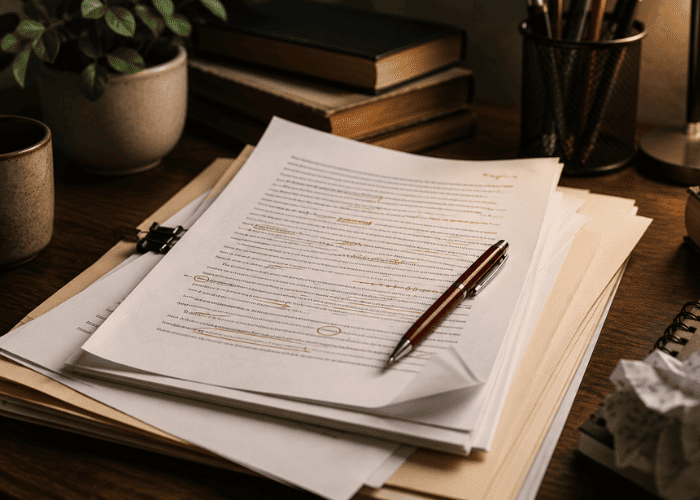
How to self-edit a book starts with structure, not sentences. Fixing commas in a chapter you might cut later wastes real time.
The Editing Process
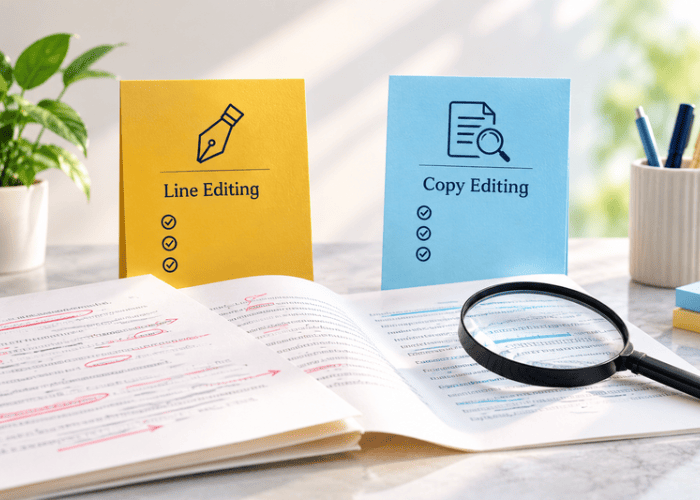
Developmental editing looks at plot, structure, pacing, and character arcs, the big picture. Line editing looks at sentence-level flow, word choice, and voice. Copyediting checks grammar, consistency, and factual accuracy. Proofreading catches what survived all three earlier passes: typos, formatting slips, stray punctuation. Do them in that order. Reversing it means polishing sentences you end up deleting anyway.
Practical Self-Editing Techniques
Read your manuscript aloud, or use text-to-speech, since your ear catches an awkward rhythm your eye skips past. Print it and mark it by hand if screen-editing has stopped working for you. Set the draft aside for at least two weeks before your first revision pass, so you read it closer to how a stranger would.
Fixing Common First-Draft Problems
A saggy middle usually means the character has nothing to actively want between the setup and the climax. Give them a new goal at the midpoint. Info-dumping means backstory arrived all at once instead of in small pieces the reader actually needed in the moment. Telling instead of showing means the manuscript states emotions, “she was angry,” instead of dramatizing them through action and dialogue.
Hiring A Professional Book Editor
Hire a developmental editor once you have a complete draft you believe in, not before. Ask for a sample edit on a few pages before committing to the full manuscript, and check that the editor has worked in your genre specifically. A thriller editor and a memoir editor look for different things.
Revise big-picture first, sentence-level last, never the reverse order. Set a draft aside for two weeks before your first real revision pass. A sample edit tells you more about a prospective editor than their résumé does.
If you’re looking for a professional book editing service to strengthen your manuscript before publication, explore our editing services. Our experienced editors help improve clarity, pacing, structure, and readability while preserving your unique voice, so your book is polished, engaging, and ready for readers.
Step 9: Get Feedback Before Publishing
Beta readers read your finished draft as a regular reader would and tell you what worked and what confused them. Critique partners give craft-level feedback earlier in the process, often chapter by chapter.
Types Of Manuscript Feedback
A beta reader represents your target audience and reacts the way a stranger in a bookstore would. A critique partner is usually a fellow writer trading feedback on craft. An editor is a paid professional trained to diagnose and fix specific problems. Use all three at different stages instead of relying on just one.
Finding Beta Readers
Genre-specific writing forums, local writing groups, and online communities built around your particular niche all work well. Avoid asking only close friends and family, since they tend to soften honest feedback out of kindness.
Preparing Beta Reader Guidelines
Give beta readers specific questions instead of asking “what did you think?” Ask where they got bored, where they got confused, and whether the ending satisfied them. Specific questions produce specific, usable answers.
Evaluating Reader Feedback
When three or more readers flag the same problem, fix it. When one reader flags something the others didn’t mention, weigh it but don’t automatically rewrite around a single opinion. Your voice isn’t up for a vote.
Beta readers, critique partners, and editors serve three different purposes, not one. Specific questions get specific, usable feedback. Fix what multiple readers flag; weigh what only one person mentions.
Step 10: Format Your Manuscript
How to format a manuscript depends on where it’s headed next: agents and publishers expect one standard, self-publishing platforms expect another.
Standard Manuscript Formatting
Agents expect double-spaced, twelve-point standard font, one-inch margins, and a header with your last name, title, and page number. Skip fancy fonts, colored text, or decorative title pages. Submission readers move fast, and any formatting oddity slows them down before they even reach your first line.
Self-Publishing File Formatting
Ebooks and print books need separate files, since ebook formatting flows to fit any screen size while print formatting locks to a fixed page. Trim size, the physical dimensions of a printed book, affects your page count and, later, your printing cost per copy.
Front Matter And Back Matter
A title page and copyright page are effectively required. A dedication, acknowledgements page, and author’s note are optional but common. Skip an elaborate table of contents in fiction; readers expect just to start reading.
Submission formatting and self-publishing formatting follow different rules, so check which one applies before you build the file. Ebook and print files are separate deliverables, not one file exported twice. Keep front matter simple in fiction.
Step 11: Choose Your Publishing Path
Self-publishing vs. traditional publishing comes down to a trade: traditional offers prestige and wide distribution in exchange for years of waiting and lower royalties; self-publishing offers speed and control in exchange for handling every cost yourself.
Traditional Publishing
Traditional publishing means a publisher buys the rights to your book, usually through a literary agent who pitches it on your behalf.
Finding A Literary Agent
How to get a literary agent starts with researching agents who represent your specific genre, then submitting a personalized query to each one rather than mass-sending an identical letter. Traditional royalties typically run eight to fifteen percent on print books and up to twenty-five percent on ebooks, paid out only after an advance earns back through sales.
Crafting A Query Letter
A query letter is a one-page pitch: a hook, a short summary of the plot or premise, your word count and genre, and a brief bio. Agents read hundreds of these a month, so the hook needs to work in the first two sentences, or the letter gets set aside.
The Nonfiction Book Proposal
Nonfiction sells differently than fiction at the query stage. A novel needs a finished manuscript before an agent will take it seriously. A nonfiction book is usually sold on a proposal alone, often before more than a sample chapter or two actually exists.
Why Nonfiction Sells Before It’s Written
A novel has to prove it works by existing. Nonfiction has to prove it will sell before it exists, since a publisher is really betting on the argument, the evidence there’s an audience, and the author’s ability to reach that audience directly. That’s the whole reason proposals run twenty to fifty pages while fiction submissions run to the very last word of the manuscript.
What A Book Proposal Includes
An overview frames the book’s core argument and why it matters right now, written with the same urgency as back-cover copy, not a dry summary. A market analysis names who buys this exact book and points to comparable titles that already sold to them. An author platform section lays out existing reach: speaking, media appearances, an email list, professional standing in the field. A chapter-by-chapter outline maps the argument one chapter at a time, one paragraph each. Sample chapters, usually one or two fully written, prove the writer can deliver what the overview promises.
Crafting A Strong Overview
Write the overview like a pitch, not a description. Weak: “This book explores productivity for remote workers.” Strong: “Remote workers lose two hours a day to decisions their office-based peers never had to make; this book gives that time back in six weeks.” The second version names a real cost and a real timeline. The first names a topic.
Building The Comp Titles Section
Publishers use comps to size a market they haven’t seen yet. Pick recent titles, published in the last three years, that sold well enough to prove real demand but aren’t so dominant that your book looks redundant sitting next to them. A comp from twenty years ago tells a publisher nothing about today’s readers.
Self-Publishing
Self-publishing means you act as your own publisher, hiring your own editor and designer, and uploading directly to platforms like Amazon KDP. How to publish a book on Amazon starts with an Amazon account, a formatted manuscript file, a cover, and a KDP dashboard where you set pricing, categories, and keywords before hitting publish. Self-published ebook royalties run up to seventy percent in the standard 2.99 to 9.99 dollar price range, though you cover every production cost yourself.
Hybrid Publishing
Hybrid publishing sits between the two: you pay the publisher for editing, design, and distribution services instead of receiving an advance, but you keep higher royalties than a traditional deal and skip most of the multi-year wait. Research any hybrid publisher carefully, since fees vary widely and some charge premium prices for work a freelance team could deliver for less.
|
Factor |
Traditional |
Self-publishing |
Hybrid |
|
Upfront cost |
None, publisher pays |
Author pays |
Author pays |
|
Typical timeline |
12 to 24 months or longer |
Weeks to a few months |
2 to 6 months |
|
Royalties |
8-15% print, up to 25% ebook |
Up to 70% ebook |
Higher than traditional, varies |
|
Creative control |
Limited |
Full |
Shared |
|
Distribution |
Bookstores, libraries |
Mostly digital, growing print |
Varies by provider |
ISBN And Copyright Essentials
An ISBN identifies a specific edition of your book and is required for most retail and library distribution. Amazon KDP provides a free ISBN for books published exclusively through their platform, though an ISBN you own yourself, usually under two hundred dollars, lets you list the same edition across multiple retailers under your own name as publisher. Copyright exists automatically the moment you write your book, but formally registering it, a modest fee through the U.S. Copyright Office, gives you stronger legal standing if anyone infringes on it.
Need help understanding the ISBN registration process? Read our complete guide on ISBN registration to learn why your book needs one, how to get it, and the steps to register it correctly before publication.
Publishing Legal Considerations
Quoting song lyrics, poetry, or long passages from other books requires permission, and “fair use” covers far less than most first-time authors assume. Memoir and narrative nonfiction carry real defamation and privacy risk when they name real people in an unflattering light, even when every word is true, so consider changing identifying details or consulting a publishing attorney for anything legally sensitive. Book titles aren’t usually protected by copyright, but using a trademarked name or brand inside your title or cover art can still cause problems.
Traditional, self-publishing, and hybrid trade off cost, speed, control, and distribution differently. An owned ISBN costs a small fee but adds flexibility across retailers. Fair use covers less than most writers assume, and memoir carries real legal risk worth planning around.
Publishing doesn’t end with writing the final chapter. Read our how to publish a book guide to understand what comes next, from preparing your manuscript to making it available to readers worldwide.
Step 12: AI And Book Writing In 2026
AI writing tools for authors are allowed on Amazon KDP, but the platform requires disclosure once AI actually generates the content that ends up in your book, not just when it assists your own writing.
AI-Assisted Vs. AI-Generated Content
AI-assisted means you wrote the book and used AI for brainstorming, outlining, or editing suggestions, which doesn’t require disclosure. AI-generated means AI produced the actual text, images, or translations that appear in the finished book, even after you edited that output, which does require disclosure.
Amazon KDP AI Disclosure Requirements
KDP’s publishing workflow includes a specific question asking whether your book contains AI-generated text, images, or translations. Answer it honestly for every title, new or updated, since Amazon has also started reviewing older backlist titles for undisclosed AI content.
Risks Of Failing To Disclose AI Content
Undisclosed AI content can get a book suppressed from sale while Amazon reviews it, permanently removed if the violation is clear, or flagged for tighter scrutiny on every future submission. Repeated violations put the whole account at risk of suspension.
AI Disclosure And Book Performance
Amazon has stated the disclosure is internal and doesn’t appear on your product page, and it doesn’t affect royalties or search ranking. What affects ranking is quality, reviews, and reader engagement, the same factors that always mattered.
Responsible AI Use For Authors
Use AI to brainstorm plot problems, summarize your own research notes, or suggest edits to sentences you already wrote. Keep the actual prose, the sentences a reader will read, written by you, even if AI helped you think it through.
The Importance Of Human Voice And Editing
Readers can often tell when a book leaned too hard on AI: a flat rhythm, sentences that sound smooth but say very little, an odd absence of the writer’s personality coming through. Heavy editing can disguise this, but the honest fix is writing the actual sentences yourself and using AI as a tool around the edges instead of the source.
Step 13: Design Your Book Cover And Interior
Book cover design signals genre before a reader reads a single word, which is why a literary novel and a romance novel almost never share a visual style, even with similar subject matter.
Genre-Focused Book Cover Design
Browse the top twenty bestsellers in your genre and notice the pattern: fonts, colors, imagery, all repeat for a reason. Readers use those visual cues to find books they already know they like. A cover that breaks the pattern too much confuses the exact reader you’re trying to reach.
Professional Vs. DIY Book Covers
A professional cover designer typically costs between two hundred and fifteen hundred dollars, depending on experience and whether the cover needs custom illustration or works from stock imagery and strong typography. DIY covers built from templates can work for some categories but rarely compete in visually crowded genres like romance or fantasy.
Interior Formatting And Typesetting
Interior formatting sets margins, font, chapter headings, and page numbers consistently through the whole manuscript. Software like Vellum or Atticus handles most of this automatically, though a professional formatter is worth the cost for anything with images, footnotes, or complex layout.
A cover’s job is signaling genre first, standing out second. Professional design typically runs 200 to 1,500 dollars depending on complexity. Formatting software handles most straightforward manuscripts without a formatter.
Step 14: Price And Launch Your Book
How to price a self-published book usually means picking a number inside your genre’s typical range, since pricing too far outside it signals something is wrong before a reader even opens the sample.
Book Pricing Strategies
Amazon’s seventy percent royalty tier applies to ebooks priced between 2.99 and 9.99 dollars. Most fiction sits in the 3.99 to 5.99 range; nonfiction often runs a bit higher given shorter typical page counts and a narrower, more motivated audience.
Building Launch Momentum With Pre-Orders
Pre-orders concentrate sales into your first week instead of spreading them out, which matters because concentrated sales trigger Amazon’s bestseller algorithms more effectively than the same total spread over a month.
Creating An Advance Reader Copy Team
An ARC advance reader copy) goes to a small group of readers before launch in exchange for an honest review posted the day the book goes live. Recruit ARC readers from your email list, relevant online communities, or readers of similar books who already left reviews you admired.
Launch Week Marketing Checklist
Email your list on launch day. Post across your social channels. Reach out to podcast hosts or bloggers in your genre ahead of time so any coverage lands during launch week, not months later. Treat launch week as the start of marketing, not the finish line.
Price inside your genre’s normal range unless you have a specific reason not to. Pre-orders concentrate sales into a launch week, which ranking algorithms reward. Launch week is a beginning, not a finish line.
Step 15: Market Your Book And Build Your Author Platform
Book marketing strategies work best when they start before your book exists, not after it launches. An email list built over months of writing beats a rushed social media push in the final week.
Building An Author Platform
An author platform is simply a way to reach readers directly, without depending on any single algorithm. Building an email list matters more than chasing followers, since a follower can miss your post but a subscriber sees your email land in their inbox.
Book Discovery Channels In 2026
BookTok and Instagram Reels drive genuine discovery for fiction, especially romance and fantasy. Podcasts and long-form YouTube work well for nonfiction authors explaining their book’s core idea. AI-powered search tools increasingly answer “what should I read about this,” which rewards authors who get mentioned by name across credible sites and reviews.
Ethical Review Strategies
Ask happy readers directly for a review instead of hoping it happens on its own. Never buy reviews or trade them with other authors, since platforms actively detect and penalize this, and it damages trust with real readers who eventually notice.
Securing Book Roundup Features
Getting mentioned in “best books for this topic” roundup articles and resource lists matters more than ever, since both search engines and AI tools pull directly from these lists when answering reader questions. Reach out to bloggers and site owners who already cover your genre or topic and offer a review copy.
Turning Your Book Into A Business Asset
A nonfiction book often functions as the front door to consulting, speaking, or course sales rather than the main source of income itself. Price and market it with that bigger picture in mind, not purely as a standalone product.
Build an email list before launch, not after. Discovery in 2026 spans social video, podcasts, and AI search, not just Amazon’s own algorithm. Nonfiction books often earn more through what they lead to than through direct sales.
If you’re searching for practical ways to help your book reach more readers, explore our book marketing services. From improving your book’s visibility to developing a targeted promotion strategy, our experienced team helps authors build an audience and create long-term momentum for their books.
Audiobook Publishing In 2026
Audiobook publishing stopped being optional the moment Amazon started counting Audible sample completion as a factor in Kindle title visibility. A book without an audio version can lose some ground even among readers who only ever buy the ebook.
Audiobook Publishing Strategy
Add an audiobook once your book has sold consistently in ebook and print for a few months, proving there’s a real audience worth the investment. A brand-new, unproven title rarely earns back audiobook production costs quickly.
Audiobook Production Options
ACX connects authors with professional narrators for a royalty split, with no upfront cost. AI narration costs far less upfront and keeps production fast, though quality and reader acceptance both vary by genre; memoir and nonfiction tolerate it better than character-heavy fiction. Self-narration works for memoir authors whose own voice is part of the book’s appeal.
Audiobook Costs And Royalties
A professionally narrated audiobook through ACX typically runs several hundred to a few thousand dollars per finished hour if you pay the narrator directly, or comes at no upfront cost through a royalty-share deal that pays the narrator a percentage of sales instead.
Audiobook Discoverability Benefits
A Kindle title bundled with an audiobook sample shows a “listen to sample” option that Amazon’s algorithm treats as an engagement signal, similar to how time spent in the “look inside” preview affects ranking.
Audiobooks now carry a real discoverability effect on Kindle, not just a separate revenue stream. Wait for proven ebook and print sales before investing in production. ACX royalty-share deals remove the upfront cost barrier for new authors.
What It Costs To Write And Publish A Book
|
Services |
Traditional Publishing |
Self-Publishing |
|
Editing |
Covered by publisher |
500 to 5,000 dollars or more |
|
Cover design |
Covered by publisher |
200 to 1,500 dollars |
|
Formatting |
Covered by publisher |
50 to 500 dollars, or DIY |
|
ISBN |
Provided |
Free through KDP, or under 200 dollars owned |
|
Marketing |
Limited publisher support |
Author-funded, highly variable |
Add these up and a self-published book typically costs somewhere between one thousand and eight thousand dollars for a properly edited, professionally designed release. Skipping editing or design to save money almost always shows up in reviews within the first month.
Traditional publishing shifts most production costs to the publisher. Self-publishing costs typically run one thousand to eight thousand dollars for a quality release. Cutting corners on editing or design tends to cost more later, in reviews and returns.
Common Mistakes First-Time Authors Make
- Committing to an idea too thin to fill a whole book, one that really wanted to be an article instead.
- Editing while drafting, which slows the first draft to a crawl and often kills momentum entirely.
- Ignoring genre word count norms so far that agents or readers assume something is structurally wrong.
- Querying agents before the manuscript is actually finished and revised.
- Publishing AI-generated content on Amazon without disclosing it, risking suppression or removal later.
- Skipping professional editing to save money on a book meant to build a career or a business.
- Building no marketing plan until the week of launch, when momentum is hardest to create from nothing.
- Chasing a trending genre with no real interest in it, which shows in flat, uninspired writing by chapter three.
Real quotes from editors, agents, or published authors you’ve actually spoken with belong in this spot. A short interview, even three or four questions over email, adds a genuine, credible voice that generic advice can’t fake. Reach out to a developmental editor, a literary agent open to interviews, or an author in your specific genre, and add their direct quote, full name, and one line of credentials once that conversation happens.
Glossary Of Book Writing And Publishing Terms
- ARC – An advance reader copy, sent to readers before launch in exchange for an honest review.
- Backlist – Books a publisher or author released more than a year ago, still generating ongoing sales.
- Beta reader – A reader who reviews a finished draft and reacts as a regular reader would, not as an editor.
- Comp titles – Recent, similar books used to show agents or algorithms where your book fits in the market.
- Developmental edit – A revision pass focused on structure, pacing, and character arcs rather than sentences.
- Frontlist – A publisher’s newly released titles for the current season.
- Ghostwriter – A writer hired to write a manuscript credited to someone else, usually based on interviews and notes.
- ISBN – A unique number identifying a specific edition of a book, used for retail and library distribution.
- KDP – Kindle Direct Publishing, Amazon’s self-publishing platform for ebooks and print-on-demand books.
- Line edit – A revision pass focused on sentence-level flow, word choice, and voice.
- Manuscript – The full text of a book before it becomes a finished, published product.
- Query letter – A one-page pitch sent to literary agents, summarizing your book and asking for representation.
- Royalty – The percentage of a book’s sale price paid to the author.
- Trim size – The physical width and height of a printed book’s pages.
Conclusion
Writing a book becomes much easier when the process feels clear, because confusion often stops more authors than lack of talent. Strong ideas create momentum, while consistent writing habits turn unfinished thoughts into completed manuscripts. Successful books rarely happen through luck, because planning, drafting, revising, publishing, and marketing work together as one complete system. First-time authors improve through practice, while experienced professionals improve through structure and refinement. Progress matters more than perfection, because every finished page moves you closer to publication. Start with one clear step today, while Pioneer Publishing Press can become part of your journey as you move toward turning your ideas into a published book.
Frequently Asked Questions
How long does it take to write a book?
Most first-time authors need six months to two years from idea to finished manuscript, including revision. Pace matters more than talent: five hundred words a day finishes an 80,000-word draft in about five months, while one thousand words a day cuts that to under three.
How many words should a book be?
Adult fiction typically runs 70,000 to 100,000 words, with 80,000 to 90,000 as the safest range for a debut. Nonfiction varies more widely, often landing between 40,000 and 90,000 depending on category.
Do I need to outline before I start writing?
Outlining isn’t mandatory, but some form of structure helps almost every writer finish faster. Plotters outline scene by scene before drafting, while pantsers often outline afterward, using their discovery draft to spot and fix structural gaps.
Can I use AI to write my book?
AI can help with brainstorming, outlining, and editing your own writing without any disclosure requirement. Having AI generate the actual text that appears in your finished book counts as AI-generated content and requires disclosure on platforms like Amazon KDP.
Do I need a literary agent to publish a book?
An agent is required to submit to most major traditional publishers, since those houses rarely accept unsolicited manuscripts directly from authors. Self-publishing and most hybrid publishers don’t require an agent at all.
How do I copyright my book?
Copyright exists automatically the moment you write original work, whether or not you register it. Formally registering with the U.S. Copyright Office costs a modest fee and provides stronger legal standing if you ever need to enforce it against infringement.
Do I need an ISBN to self-publish?
Amazon KDP provides a free ISBN if you publish exclusively through their platform. An ISBN you purchase and own yourself, usually under two hundred dollars, lets you distribute the same edition across multiple retailers under your own publisher name.


Pingback: How Much Does a Ghostwriter Cost? 2026 Pricing Guide
Pingback: 20 Questions to Ask a Ghostwriter Before a Deposit (2026)
Pingback: 7 Types of Book Editing Every Author Must Know (2026)